术语表
用語集
The terms you will meet watching a tournament or reading results, grouped by where they come up. The winning techniques have a searchable table of their own, further down.
- Rikishi 力士
- 相扑力士。字面意为「力之士」,也称相扑取。
- Sekitori 関取
- 十両以上、可领薪俸的力士。
- Yokozuna 横綱
- 最高位。得名于腰间所系之綱。
- Ōzeki 大関
- 第二位。连续两场所负越即降格。
- San'yaku 三役
- 横纲之下的三役:大关、关胁、小结。
- Maegashira 前頭
- 幕内的平幕,自第一枚起依次编号。
- Oyakata 親方
- 部屋师匠,持有年寄名迹的退役力士。
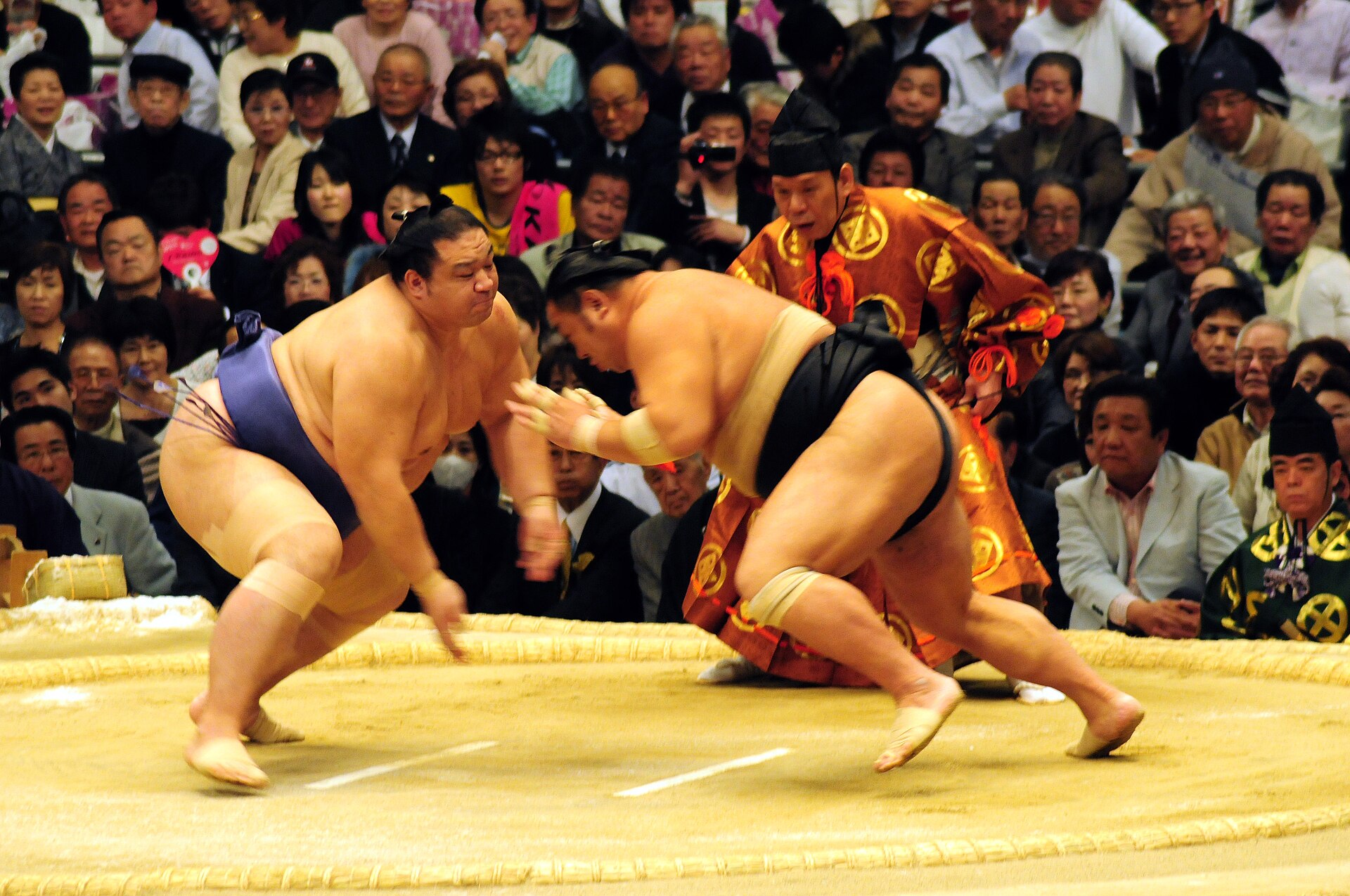
- Gyoji 行司
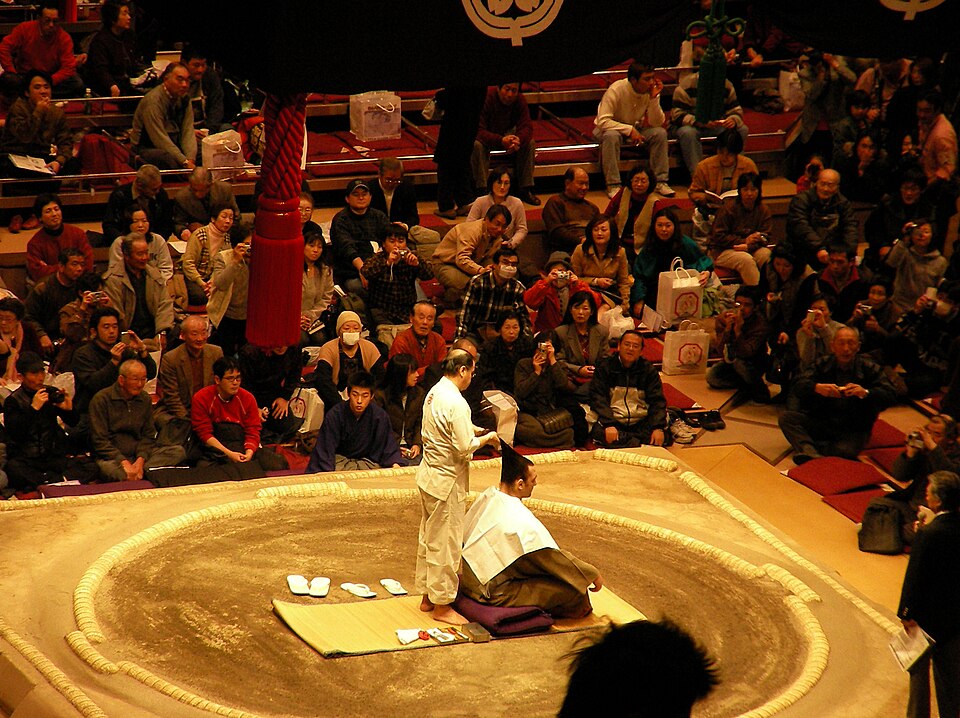
- 土俵上的行司,身着装束、手持军配。
- Shimpan 審判
- 土俵下的五位审判委员,其判断高于行司。
- Yobidashi 呼出
- 呼出:唱名、扫土俵、击太鼓。
- Tokoyama 床山
- 床山:负责梳结发髻的专职人员。
- Tsukebito 付け人
- 付人:被指派照料关取起居的下位力士。
- Basho 場所
- 场所。每年六次,每次十五天。
- Honbasho 本場所
- 本场所:成绩计入番付的正式赛事。
- Banzuke 番付
- 番付表:每场所前以毛笔书写发布的排位表。
- Torikumi 取組
- 取组:赛程编成,也指个别对战。
- Senshūraku 千秋楽
- 千秋乐:本场所的最后一天。
- Yūshō 優勝
- 优胜:各段成绩最佳者所得。
- Kachikoshi 勝ち越し
- 胜越:十五番中取得八胜以上,番付上升。
- Makekoshi 負け越し
- 负越:成绩为负,番付下降。
- Kinboshi 金星
- 金星:平幕战胜横纲,可获得终身加给。
- Hoshitori 星取表
- 星取表:逐日记录,实心圈为胜,空心圈为负。
- Kyūjō 休場
- 休场:因伤病缺席。
- Fusenshō / fusenpai 不戦勝・不戦敗
- 不战胜/不战败:因对手休场而定的胜负。
- Jungyō 巡業
- 巡业:两场所之间的地方巡回表演。
- Kenshō 懸賞
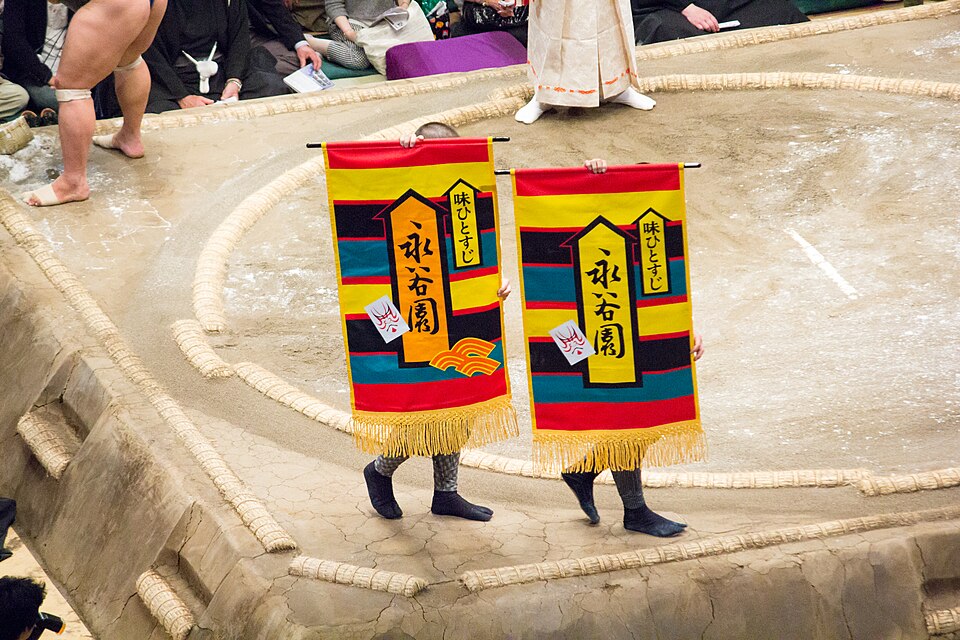
- 悬赏:赛前以旗幡巡示、赛后交予胜者的赞助奖金。
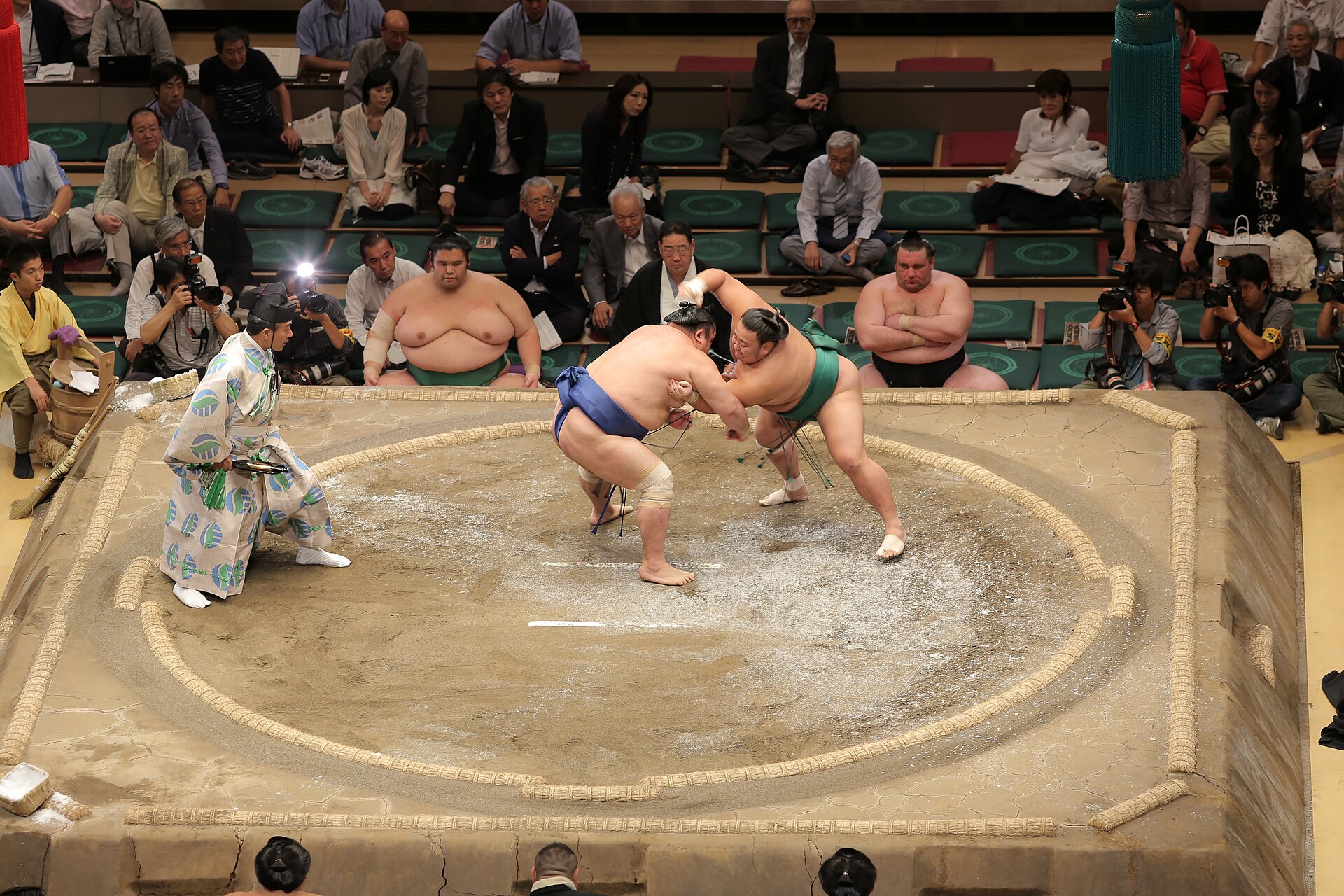
- Dohyō 土俵
- 土俵:每场所重新筑造的黏土台。
- Tawara 俵
- 俵:标示土俵边缘的稻草包。
- Tokudawara 徳俵
- 德俵:四处稍向外错开的俵,为力士留出一线余地。
- Shikiri-sen 仕切り線
- 仕切线:相距 70 公分的两条白线。
- Tachiai 立合い
- 立合:起始冲撞,双方须同时而起。
- Matta 待った
- 待った:起跑失败、重新来过。
- Shikiri 仕切り
- 仕切:立合前的准备仪式。
- Shiko 四股
- 四股:高抬腿踏地,既是驱邪,也是基础锻炼。
- Chikaramizu 力水
- 力水:由同侧前一场胜者递上的水。
- Kimarite 決まり手
- 决まり手:分出胜负的技法。
- Mono-ii 物言い
- 物言:审判委员就判定进行的合议。
- Torinaoshi 取り直し
- 取り直し:难分胜负时的重赛。
- Shini-tai 死に体
- 死に体:体势已无可挽回者,即便对手先落地也判其负。
- Kinjite 禁じ手
- 禁じ手:使用即判负。
- Hansoku 反則
- 反则:因犯规而判负。
- Mawashi まわし
- まわし(腰带):关取用绢,下位用棉。
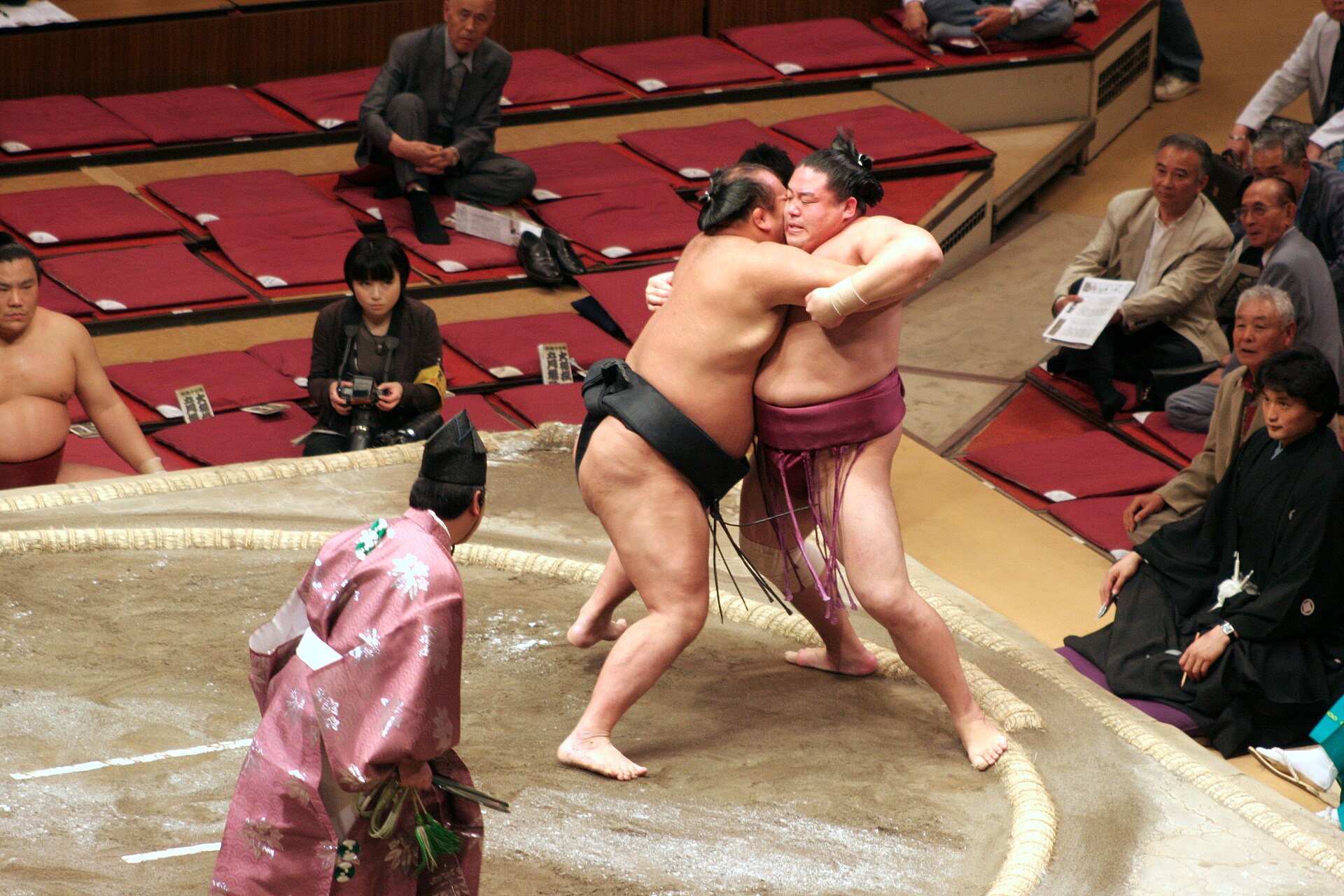
- Yotsu-zumo 四つ相撲
- 四つ相扑:抓带角力,以组手取胜。
- Oshi-zumo 押し相撲
- 押し相扑:不抓带,以推突进攻。
- Uwate 上手
- 上手:自对手手臂外侧抓带。
- Shitate 下手
- 下手:自对手手臂内侧抓带。
- Migi-yotsu / hidari-yotsu
- 右四つ/左四つ:力士几乎都有惯用的一侧。
- Morozashi 双差し
- 双差:双臂皆入内侧,占绝对优势。
- Tsuppari 突っ張り
- 突っ張り:向胸口与咽喉连续推击。
- Harite 張り手
- 张手:以掌击面。虽不违规,但横纲使用会招致非议。
- Henka 変化
- 变化:立合瞬间闪身。有效,但普遍不受欢迎。
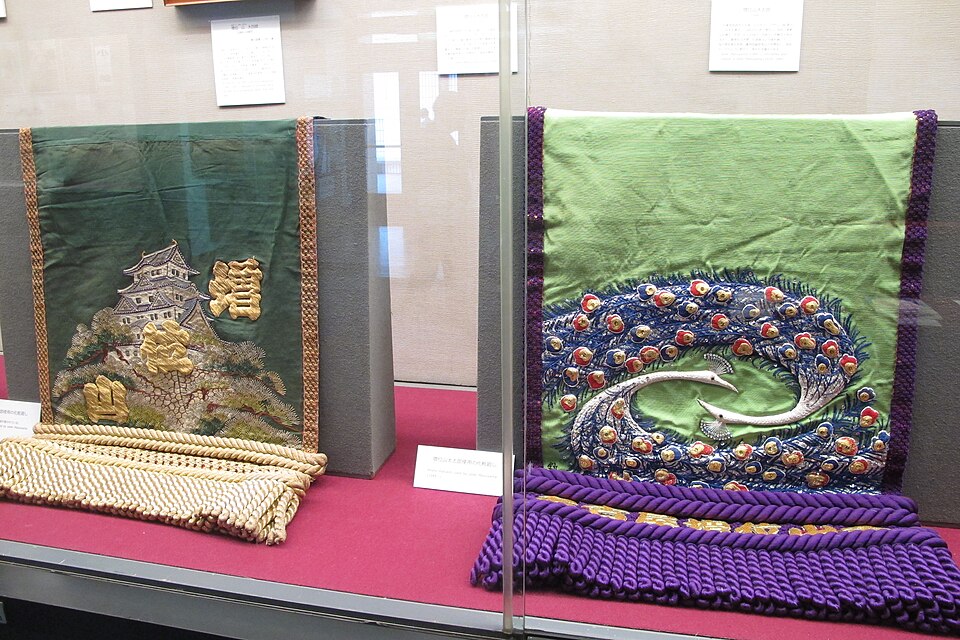
- Keshō-mawashi 化粧まわし
- 化妆まわし:土俵入时所着的刺绣前垂。
- Dohyō-iri 土俵入り
- 土俵入:入场仪式。
- Tsuna 綱
- 綱:横纲所系白绳,重达 20 公斤。
- Unryū / Shiranui 雲龍・不知火
- 云龙型与不知火型:横纲土俵入的两种样式。
- Chonmage 丁髷
- 丁髷:所有力士皆结的发髻。
- Ōichō 大銀杏
- 大银杏:关取比赛时所结的银杏叶形发髻。
- Danpatsu-shiki 断髪式
- 断发式:剪去发髻的引退仪式。
- Heya 部屋
- 部屋:力士起居与训练之所。
- Chanko-nabe ちゃんこ鍋
- ちゃんこ锅:力士饮食的主食火锅。
- Shikona 四股名
- 四股名:力士的雅号,多由师匠所赐。
- Hinkaku 品格
- 品格:与地位相称的品位。晋升横纲的正式要求,却无法量化。
90 种决まり手
決まり手
Every bout is officially assigned a kimarite — the technique that finished it. The Sumo Association recognises 82 winning techniques plus a set of non-technique outcomes. The figures below are real: total recorded uses of each technique in professional sumo since 1958.
What it shows is how lopsided the sport is. Two techniques account for a little over half of all sumo ever recorded, and the bottom forty are rarer than most fans will see in a lifetime of watching.
| Technique | Meaning | Type | Recorded uses |
|---|
规则
相撲の規則
The rules are famously short. Two ways to lose, and that is nearly all of it:
There are no weight classes, no rounds and no points. A 98 kg man can be drawn against one of 180 kg, and regularly is. Bouts are decided in seconds — the great majority inside ten — which is why the preparation takes four minutes and the fight itself often takes four seconds.
禁手(禁じ手)
A handful of techniques bring immediate disqualification (hansoku): striking with a closed fist, grabbing the hair, gouging the eyes or solar plexus, seizing the throat, kicking the chest or stomach, bending fingers back, and grasping the vertical front fold of the opponent's belt. Open-hand slapping to the face, by contrast, is entirely legal and common.
难分胜负时
The referee must always point his fan to a winner — he is not allowed to hesitate. If the five ringside judges disagree, they climb into the ring for a conference (mono-ii) and may uphold the call, reverse it (sashichigae), or order the bout fought again (torinaoshi). A rikishi who is already falling irrecoverably may still be ruled the winner under the shini-tai "dead body" principle, because his opponent's defeat was inevitable first.
土俵
土俵
The ring is built from scratch for every tournament out of a particular clay, and dismantled afterwards. It is not a floor so much as an altar: a roof in the style of a Shinto shrine hangs above it, and the four coloured tassels at its corners stand for the seasons and the guardian beasts of the four directions.
Four of the bales are set slightly outside the circle at the compass points. These are the tokudawara, and the small pocket of space they create has saved countless rikishi from stepping out — a survival that is very much part of the ring's design rather than an accident of it.
Women are not permitted to enter the dohyō. The Japan Sumo Association maintains the ring is a sacred space under Shinto practice; the rule has drawn sustained criticism, most sharply in 2018 when officials asked nurses to leave the ring while they were giving first aid to a collapsed mayor.
番付与阶级
番付
Everything in sumo is rank. It sets a man's pay, whether he may wear silk, who carries his bags, and whether he is a salaried professional or an unpaid apprentice. The ranking sheet — the banzuke — is published thirteen days after each tournament, hand-brushed in a dense calligraphic style called sumo-ji, and the size of the lettering shrinks with rank. The list below is set the same way.
关键的分界线
The meaningful border is between jūryō and makushita. Above it a man is sekitori: he draws a salary, wears a silk belt, has junior wrestlers to attend him and fights fifteen bouts a tournament. Below it he is an apprentice on an allowance, fights seven, does the chores, and eats after his seniors have finished.
胜越与负越
A winning record — kachikoshi, eight wins or better from fifteen — moves a man up. A losing record, makekoshi, moves him down. The whole ladder turns on that single figure of eight.
晋升上位
Promotion to ōzeki is conventionally taken to need roughly 33 wins across three consecutive tournaments at sekiwake or komusubi. Yokozuna promotion requires two consecutive championships as ōzeki, or the equivalent, plus a judgement about dignity — hinkaku — which is deliberately not quantified. A yokozuna can never be demoted; if he can no longer perform to the rank, he is expected to retire instead.
仪式
儀式
土俵入
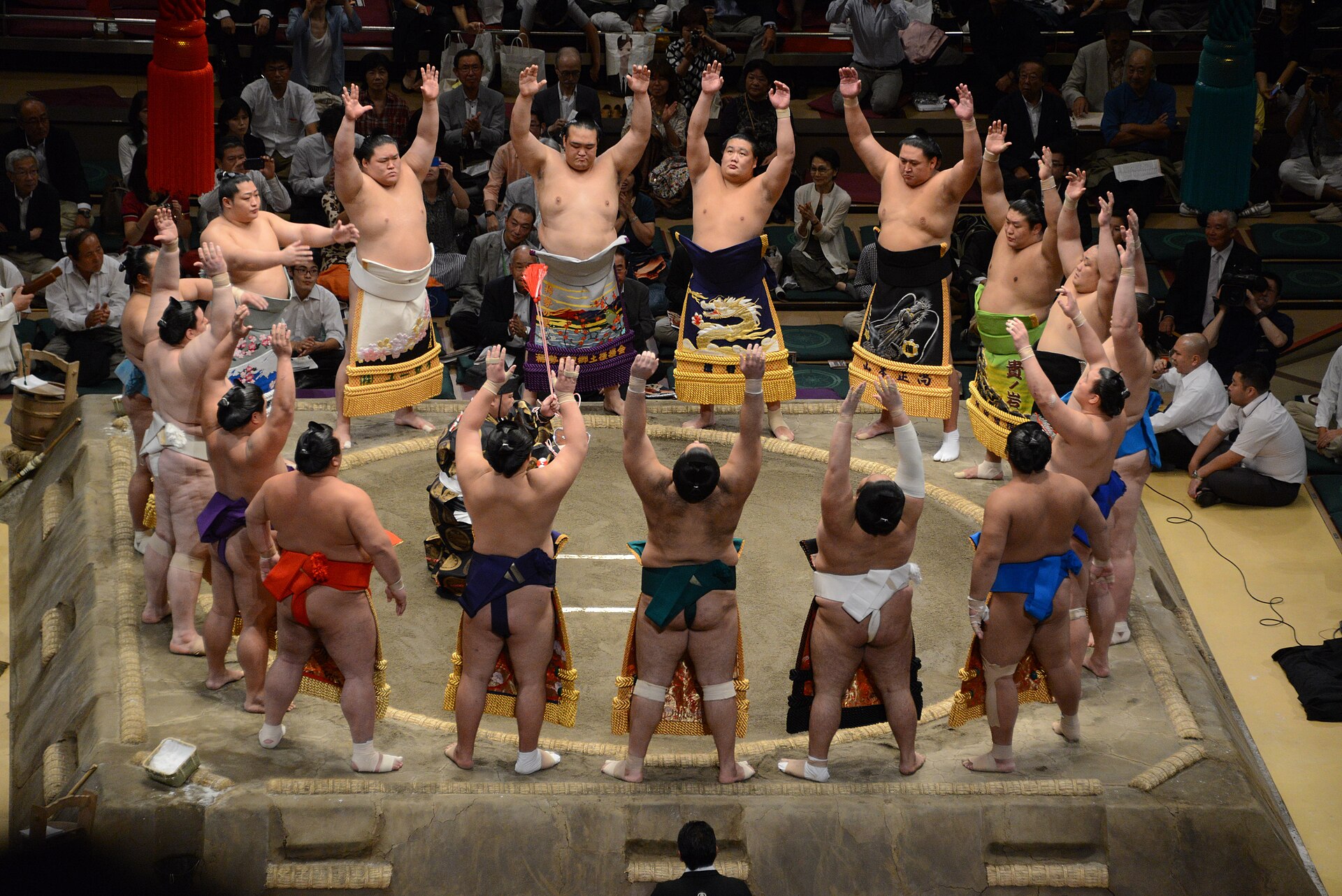
Before the day's bouts, the wrestlers of each division enter the ring in ascending order of rank, wearing keshō-mawashi — heavy silk aprons, embroidered and fringed in gold, often paid for by a supporters' association and costing as much as a car. They form a circle, face outward, then turn inward, clap, raise one hand, lift the apron slightly and raise both hands. The gesture means the same thing it has always meant: I carry no weapon.
横纲土俵入
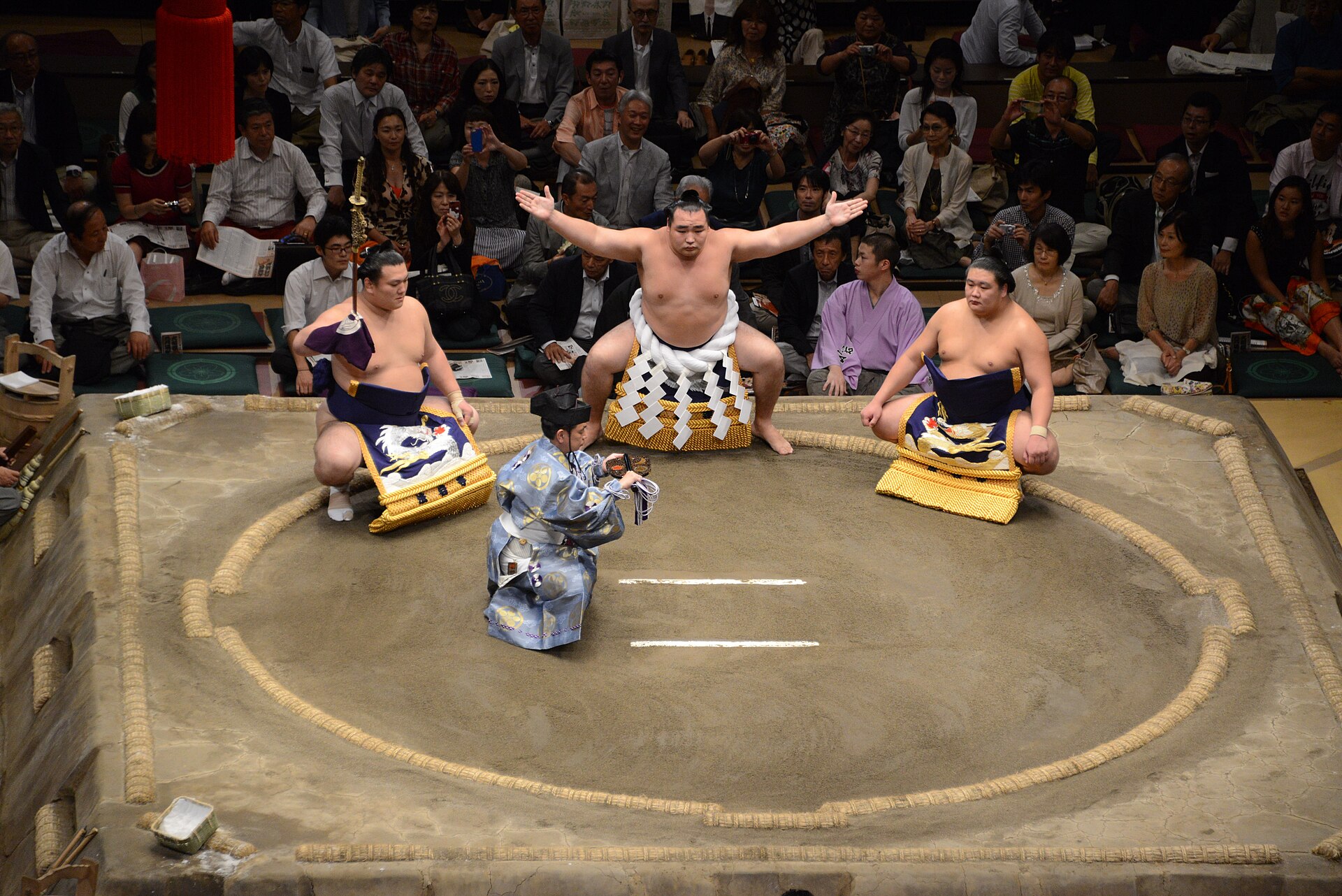
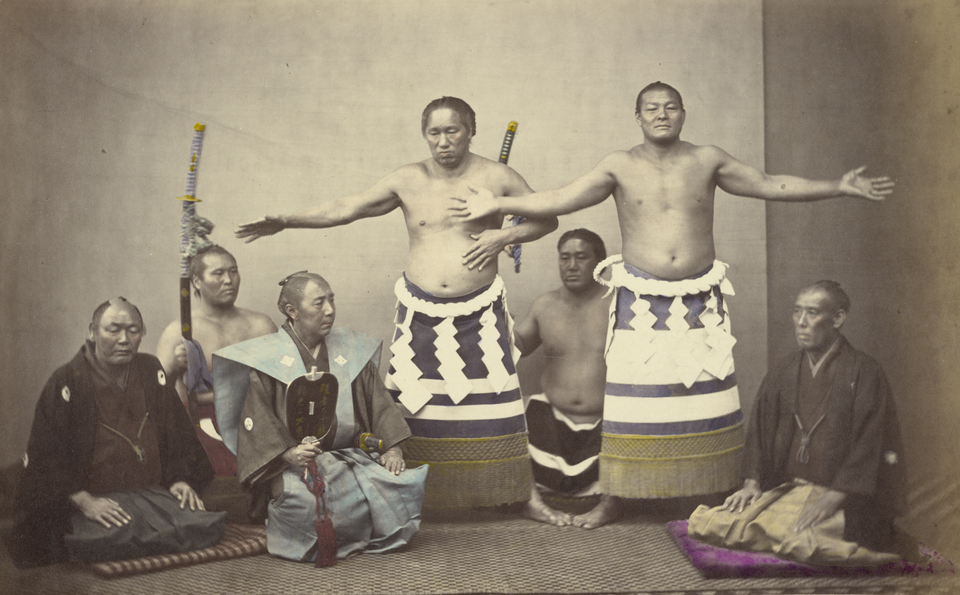
A yokozuna does not appear in the group. He performs alone, wearing the white tsuna — a rope of up to twenty kilograms, hung with folded paper zigzags of the kind found at shrine gates — and attended by a sword-bearer (tachimochi) and a herald (tsuyuharai). He claps to summon the gods' attention, spreads his arms with palms up to show he is unarmed, then raises each leg high and brings it down with a heavy stamp — shiko — driving evil out of the ring.
There are two styles, and a yokozuna picks one for his career. Unryū ties the rope in a single loop and leaves one arm bent — read as defensive. Shiranui ties two loops and spreads both arms wide — read as aggressive, and superstitiously reckoned unlucky, since several who chose it had short reigns.
本场所落幕
The wrestler with the best record in the top division takes the yūshō and the Emperor's Cup. If two or more finish level, they meet in a play-off on the spot. Three special prizes may also be awarded to maegashira-ranked wrestlers: shukun-shō for outstanding performance, kantō-shō for fighting spirit, and ginō-shō for technique.
行司与审判
行司・審判
The gyoji is far more than a referee. He wears court dress modelled on the samurai style of some 800 years ago, calls the wrestlers up, sets the bout in motion, judges it, and between tournaments hand-writes the banzuke in the calligraphic style the job requires. Gyoji are ranked as strictly as the wrestlers are, and you can read a man's rank off his equipment.
| Gyoji rank | Tassel on the fan | Footwear |
|---|---|---|
| Tate-gyoji (top) | Purple, or purple and white | Tabi and straw sandals |
| San'yaku | Vermillion | Tabi and straw sandals |
| Makuuchi | Red and white | Tabi |
| Jūryō | Blue and white | Tabi |
| Lower divisions | Blue, or black | Barefoot |
Only a tate-gyoji may officiate a yokozuna's bout. The two most senior carry the inherited professional names Kimura Shōnosuke and Shikimori Inosuke, and by long tradition each carries a short sword — a formal reminder that a wrong call was once a matter for ritual suicide. In practice a modern gyoji whose decision is overturned submits a resignation, which is politely refused.
审判委员
Five shimpan — retired wrestlers now elders of the Association — sit at the four sides and one corner of the ring. They, not the gyoji, have the final say. Any of them may call a mono-ii and stop proceedings, and video review has been used since 1969.
仕切
仕切り
In the top division a bout is preceded by four minutes of ritual, and the ritual is the part most spectators travel to see. It is not stalling; every element of it is prescribed.
撒盐
Each wrestler takes a handful from baskets at the east and west of the ring and scatters it across the clay, purifying the sacred ground and praying for a safe bout. It has a practical function too — it disinfects the small cuts and grazes that come with the work. Roughly 45 kilograms of salt are thrown across a fifteen-day tournament.
力水
A wrestler rinses his mouth with water handed to him by the winner of the previous bout on his side, or by the man due to fight next if his side lost. A defeated wrestler may not pass the water on; the gesture carries only from strength.
四股与蹲踞
The leg-lifting stamp drives evil from the ring and is also the sport's foundational training exercise. Then the wrestlers squat at the two starting lines, clap, spread their arms and turn their palms down — again, no weapons — and settle into the crouch, fists to the clay.
立合
There is no starting signal. The two men must synchronise it themselves: both fists must touch the ground, and the charge begins the instant they agree, silently, that it has. A mistimed start (matta) is reset and disapproved of. This moment decides more bouts than any technique does.
本场所之年
本場所
Six tournaments a year, each fifteen days, always beginning and ending on a Sunday. Top-division wrestlers fight once a day, every day.
| Month | Tournament | City | Venue |
|---|---|---|---|
| January | Hatsu basho | Tokyo | Ryōgoku Kokugikan |
| March | Haru basho | Osaka | EDION Arena |
| May | Natsu basho | Tokyo | Ryōgoku Kokugikan |
| July | Nagoya basho | Nagoya | IG Arena |
| September | Aki basho | Tokyo | Ryōgoku Kokugikan |
| November | Kyūshū basho | Fukuoka | Fukuoka Kokusai Center |
Between tournaments the wrestlers tour — jungyō — giving exhibitions in regional towns. These bouts are not competitive and do not count towards any record.
力士的生活
力士の生活
Wrestlers live in a heya — a stable — under a stablemaster who is a retired wrestler himself. Juniors sleep in communal rooms, rise around five, and train on an empty stomach. Only sekitori may sleep apart, marry and live outside.
为何是这样的体格
There is no weight limit, so mass is an advantage and is deliberately built. Training happens before eating; the day's first meal is chanko-nabe, a protein-heavy hotpot eaten in enormous quantity and followed by sleep, which is precisely how you gain weight. Juniors cook it and serve it, and eat last.
发髻、腰带与着装
Every wrestler wears the topknot — chonmage — dressed by a specialist hairdresser, the tokoyama. Sekitori wear the elaborate ginkgo-leaf style, ōichō, for bouts. In public a wrestler must wear traditional dress; junior men are restricted to a thin cotton robe and wooden sandals even in winter. At retirement, the topknot is cut off in a public ceremony, the danpatsu-shiki, by hundreds of guests in turn, with the stablemaster making the final cut.
收入
Below jūryō there is no salary — only a modest tournament allowance. Reaching jūryō changes a man's life overnight: a monthly salary, prize money, a personal attendant, and the right to wear silk.
起源
起源
Sumo's founding story is a death match. In the Nihon Shoki, the eighth-century chronicle, a strongman named Taima-no-Kehaya boasts that no one alive can match him. The emperor summons Nomi-no-Sukune to answer it. Sukune breaks his opponent's ribs and then his back, and is rewarded with Kehaya's land. He is still venerated as the patron of the sport.
What followed was less violent and more agricultural. For three centuries the Imperial Court staged sumai no sechie — ritual bouts held to divine the year's harvest and to entertain the emperor. Sumo was liturgy before it was spectacle, and the rituals that survive today, the salt and the stamping and the roof over the ring, are the residue of that.
Nomi-no-Sukune defeats Taima-no-Kehaya
Recorded in the Nihon Shoki. Sukune becomes the sport's patron deity.
Sumai no sechie at the Heian court
Annual ritual matches tied to the harvest, held for roughly 300 years before the court's decline ended them.
The warrior centuries
With the court eclipsed, sumo becomes military training for the samurai class and a fixture of shrine festivals.
Sumo turns professional
Fundraising tournaments for shrines and temples — kanjin-zumo — become paid public entertainment. The ranking sheet, the ring and the referee's authority all take their modern shape here.
The first Kokugikan opens
Sumo moves indoors in Ryōgoku and is formally styled the national sport.
Six tournaments a year
The modern calendar settles into its present shape. Every bout from this year onward is in the record — which is where the figures on this page come from.